
WHAT IS OSTEOPATHY?
WHAT OSTEOPATHY DOES
WHERE IT IS USED
- Session length
- 40 – 60 min
- Sessions needed
- Usually 3 – 5
- Anaesthetic
- Not required
- Pain
- Minimal
- Back to normal
- Same day
- First effect
- 1 – 2 sessions
- Applied by
- Physiotherapist trained in osteopathy
- Where
- Your own home
The session, step by step
An osteopathy session is carried out by your physiotherapist in your own home. Assessment and treatment together take about an hour.
- I. HISTORY
Listening
Your complaint, when it started, past injuries, operations and the strains of your daily life are gone through in detail. In osteopathy the history matters as much as the examination.
- II. EXAMINATION
Whole-body assessment
Not only the painful area: your posture, your gait, the balance of the spine and pelvis and the mobility of the joints are all assessed by hand. The source of the pain is often somewhere other than where it is felt.
- III. TREATMENT
Hands-on work
Soft tissue techniques, joint mobilisation and muscle-fascia release. The techniques are slow and controlled; nothing forceful or sudden is done.
- IV. FOLLOW-UP
Home programme
At the end of the session you are given a few specific movements and advice for daily life. The timing of the next session is planned according to how you respond.
Why patients choose it
What stands out when it is compared with treatment aimed only at the painful area.
A whole-body view
The work is aimed at the chain that produces the pain, not the spot that hurts. Lower back pain can start at the ankle or the hip.
No drugs, no devices
The treatment is entirely manual. No medication, no needle, no machine.
Results in few sessions
Because the work targets the source, three to five sessions are enough for most patients.
Range of movement
When restricted joints regain their mobility, posture and walking become noticeably easier.
Lasting with exercise
What the session gains is kept with the home programme, so the complaint is less likely to return.
Done at home
No clinic journey and no waiting. It is carried out in your own surroundings, which most patients find more comfortable.
What is osteopathy based on?
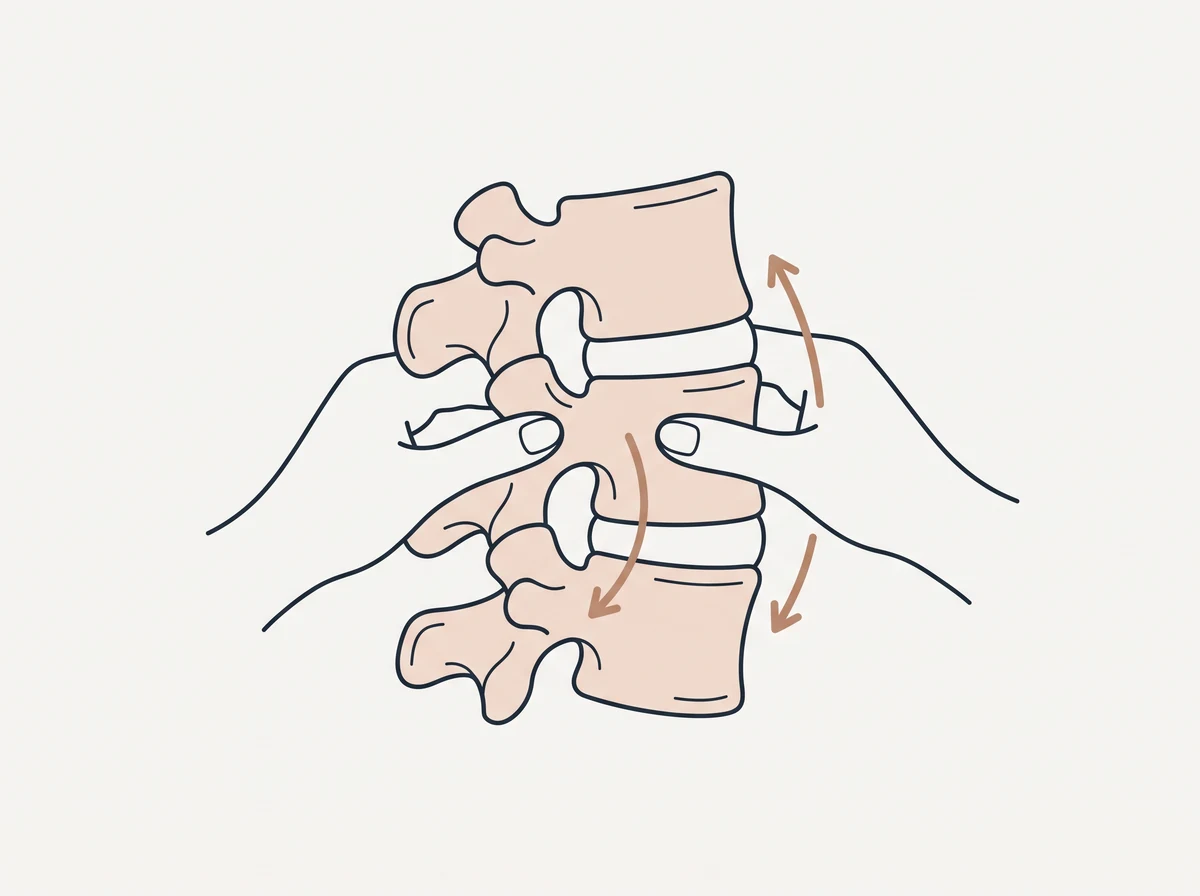
The starting point of osteopathy is that the body is a single connected structure. When one joint loses movement, the body compensates by working another region harder. In time the pain appears not where the problem is, but where the extra load has fallen.
For that reason osteopathy looks for the source of the pain, not its location. Joint mobility, tension in the fascia that wraps muscles and organs, and local circulation are all assessed by hand, and what is restricted is freed with gentle techniques.
Which complaints is it used for?
• Recurring lower back, upper back and neck pain
• Widespread muscular tension related to posture
• Tension-type headaches and jaw joint problems
• Movement restrictions left by an old injury or operation
• Lower back and pelvic pain in pregnancy and after birth
• Musculoskeletal pain that moves around and has no clear cause
Osteopathy and manual therapy are not the same
Manual therapy addresses the painful joint or muscle directly; its target is local. Osteopathy takes the body as a whole, may look for the source of the pain in another region, and brings fascia, circulation and breathing into the assessment. They are not alternatives to each other — most of the time they are used together in the same programme.
What patients ask most
How will I feel after a session?
Most patients feel released and lighter. Mild muscle fatigue, or the pain briefly increasing, is normal in the first 24 to 48 hours as the body adjusts to its new balance. Drinking water and avoiding heavy exercise that day makes it easier.
How many sessions will I need?
It depends how long the complaint has lasted. One or two sessions can be enough for something recent; long-standing problems are planned over three to five. Sessions are usually a week apart.
Is the clicking sound from the joint harmful?
No. The sound comes from a gas bubble in the joint fluid released by a change in pressure; it is not a bone moving out of place. Not every osteopathic technique makes a sound, and the sound does not mean the treatment worked.
Is osteopathy the same as massage?
No. Massage focuses on relaxing muscles. Osteopathy begins with a detailed examination and then selects specific techniques for the joint, muscle and fascia. The aim is not relaxation but the removal of a movement restriction.
Who should not have it?
Medical clearance is needed for patients with advanced osteoporosis, recent fractures and dislocations, spinal tumour or infection, advanced vascular disease, and for patients on blood thinners. Where a technique is not appropriate it is changed, or the treatment is not carried out.
Is osteopathy right for you?
Let us assess where the problem starts. Our physiotherapist comes to your home, carries out a detailed examination, says whether osteopathy is appropriate and sets out a programme. This first assessment is free.
Call us+90 (212) 983 40 67
This page is for information only and does not replace examination or medical diagnosis.