
WHAT IS ELECTROTHERAPY?
WHY ELECTROTHERAPY?
- Session length
- 20 – 30 min
- Sessions needed
- Usually 10 – 15
- Anaesthetic
- Not required
- Pain
- None
- Back to normal
- Same day
- First effect
- 2 – 3 sessions
- Applied by
- Physiotherapist
- Where
- Your own home
The session, step by step
Electrotherapy is applied by your physiotherapist using portable equipment in your own home. Including preparation, the visit takes about half an hour.
- I. ASSESSMENT
Examination
Where the pain is, how severe it is and how long it has lasted. A pacemaker, pregnancy or a skin wound — anything that rules out current — is identified at this stage.
- II. PREPARATION
Placing the electrodes
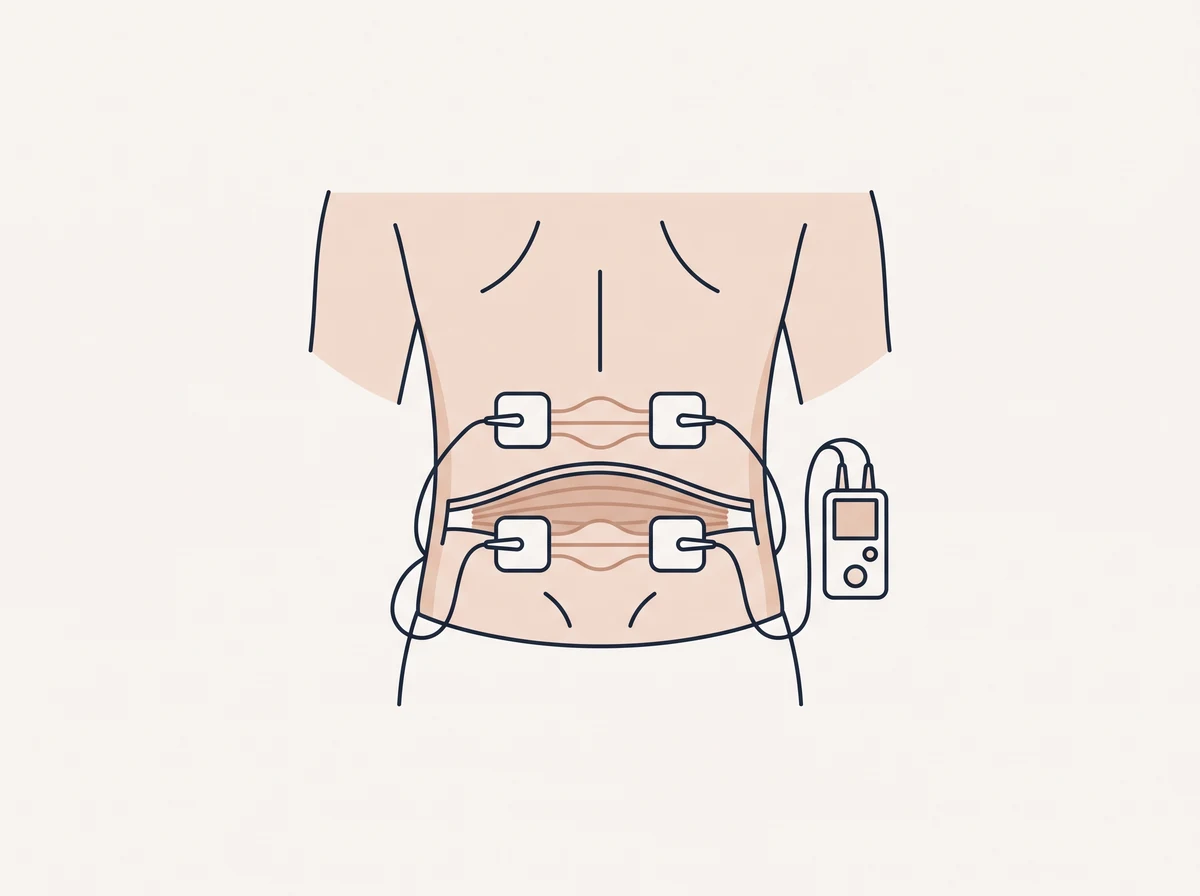
The area is cleaned and single-use gel pads are placed to cover the painful region or the nerve involved. The device is portable, so no special room is needed.
- III. TREATMENT
Current and heat
The intensity is raised slowly and held at a level that feels comfortable — a light tingling. The application lasts 20 to 30 minutes and is not painful. Heat or cold is added where it helps.
- IV. FOLLOW-UP
Exercise and programme
Once the pain has eased, the exercises for that day are carried out. Your physiotherapist sets the frequency of sessions and shows you what to do on the days in between.
Why patients choose it
What stands out when it is compared with pain medication.
Pain control without drugs
It reduces the need for painkillers, easing pain without the load that medication places on the stomach, kidneys and liver.
Painless to receive
What you feel is a light tingling. The intensity is set by asking you, so it does not become uncomfortable.
Makes exercise possible
With the pain down, strengthening and range-of-movement work can be done properly — which is where the lasting result comes from.
Swelling and circulation
Certain currents increase blood flow through the area and help swelling clear faster.
Slows muscle loss
After a stroke or a long period in bed, muscles that cannot work are stimulated electrically and preserved.
Done at home
The devices are portable. No clinic journey, no waiting, no patient transfer.
How does electrical current reduce pain?
Low-intensity current delivered through the skin stimulates the thick nerve fibres, which conduct faster than the thin fibres that carry pain. At spinal cord level that signal gets there first and the pain message is dampened. This is known as the gate control mechanism.
Other current types increase the release of the body's own painkillers and speed up local blood flow. Current applied directly to a muscle makes it contract, which slows the wasting that follows disuse.
Which complaints is it used for?
• Lower back, neck and upper back pain
• Muscle spasm and trigger point pain
• Nerve compression from a lumbar or cervical disc herniation
• Pain from osteoarthritis of the knee and shoulder
• Swelling and stiffness after surgery
• Stimulation of muscles that are not working after a stroke
Is electrotherapy enough on its own?
Electrotherapy reduces pain and supports tissue healing, but it does not strengthen a weak muscle and it does not correct posture. Used alone, its effect is temporary. The right approach is to use the window of reduced pain for exercise and manual therapy, which is where the lasting result comes from.
What patients ask most
Does electrotherapy hurt?
No. You feel a tingling or a light vibration. The intensity is set by asking you and is not taken to an uncomfortable level.
How many sessions will I need?
It depends on the complaint. A few sessions can be enough for acute pain, while chronic pain and stroke rehabilitation are treated over programmes of ten to fifteen. The first effect is usually felt within two or three sessions.
Can I use a personal device at home?
Consumer TENS units are low powered. Placing the pad in the wrong position makes the treatment useless and can sometimes make the complaint worse. The safest course is to have the first applications done by a physiotherapist, who will then show you how to use the device.
Which currents are used?
Most often TENS for pain control, interferential current for deeper tissue, and galvanic and faradic currents for muscle stimulation. Ultrasound and heat are frequently added. The choice is made by the physiotherapist according to the complaint.
Who should not have it?
It is not used for people with a pacemaker or similar implant, over the abdomen and lower back in pregnancy, where there is an open wound, infection or tumour in the area, in advanced heart failure, or over regions with loss of sensation.
Is electrotherapy right for you?
Let us assess the source of your pain where you are. Our physiotherapist comes to your home, examines you, tells you whether electrotherapy is appropriate and sets out a programme. This first assessment is free.
Call us+90 (212) 983 40 67
This page is for information only and does not replace examination or medical diagnosis.






Yes, when the right current is chosen and the pads are placed correctly. There are situations where it is not used at all — a pacemaker, pregnancy, an open wound — and those are checked before the first session.


