
WHAT IS DRY NEEDLING?
WHY DRY NEEDLING?
DOES DRY NEEDLING HURT?
IS IT RISKY?
- Session length
- 15 – 30 min
- Sessions needed
- Usually 3 – 6
- Anaesthetic
- Not required
- Pain
- Minimal
- Back to normal
- Same day
- First effect
- 1 – 2 sessions
- Applied by
- Certified physiotherapist
- Where
- Your own home
The session, step by step
Dry needling is carried out by your physiotherapist in your own home. Including preparation, the whole visit takes under an hour.
- I. ASSESSMENT
Examination
Your physiotherapist listens to your complaint, examines the relevant muscles by hand and locates the trigger points behind the pain. Medication you take and any chronic conditions are asked about at this stage.
- II. PREPARATION
Hygiene
The area is exposed and the skin cleaned with antiseptic. Only single-use, sterile needles are used, opened from the packet in front of you.
- III. TREATMENT
Needling
The needle is placed into the trigger point. A short twitch response may occur in the muscle — that is the spasm beginning to release. A wider painful area means more needles. The application takes 15 to 30 minutes.
- IV. AFTERWARDS
Follow-up
Mild muscle soreness for 24 to 48 hours is normal. Drink plenty of water that day and avoid heavy exercise. Your physiotherapist plans the next session and gives you the supporting exercise programme.
Why patients choose it
What stands out when it is compared with other treatments for muscle pain.
No medication
A dry needle contains no drug and no solution, so there is no risk of an allergic reaction or a drug side effect.
Works quickly
Most patients feel the pain ease within the first one or two sessions; as the spasm releases, range of movement improves.
Short session
Fifteen to thirty minutes. It fits into your programme without disrupting your day.
No recovery time
No rest is needed afterwards. You return to your normal routine the same day.
Done at home
No clinic journey, no waiting room, no patient transfer — a real difference for anyone with limited mobility.
Lasting result with exercise
Once the spasm releases, strengthening and posture work become far more effective, and the pain is less likely to return.
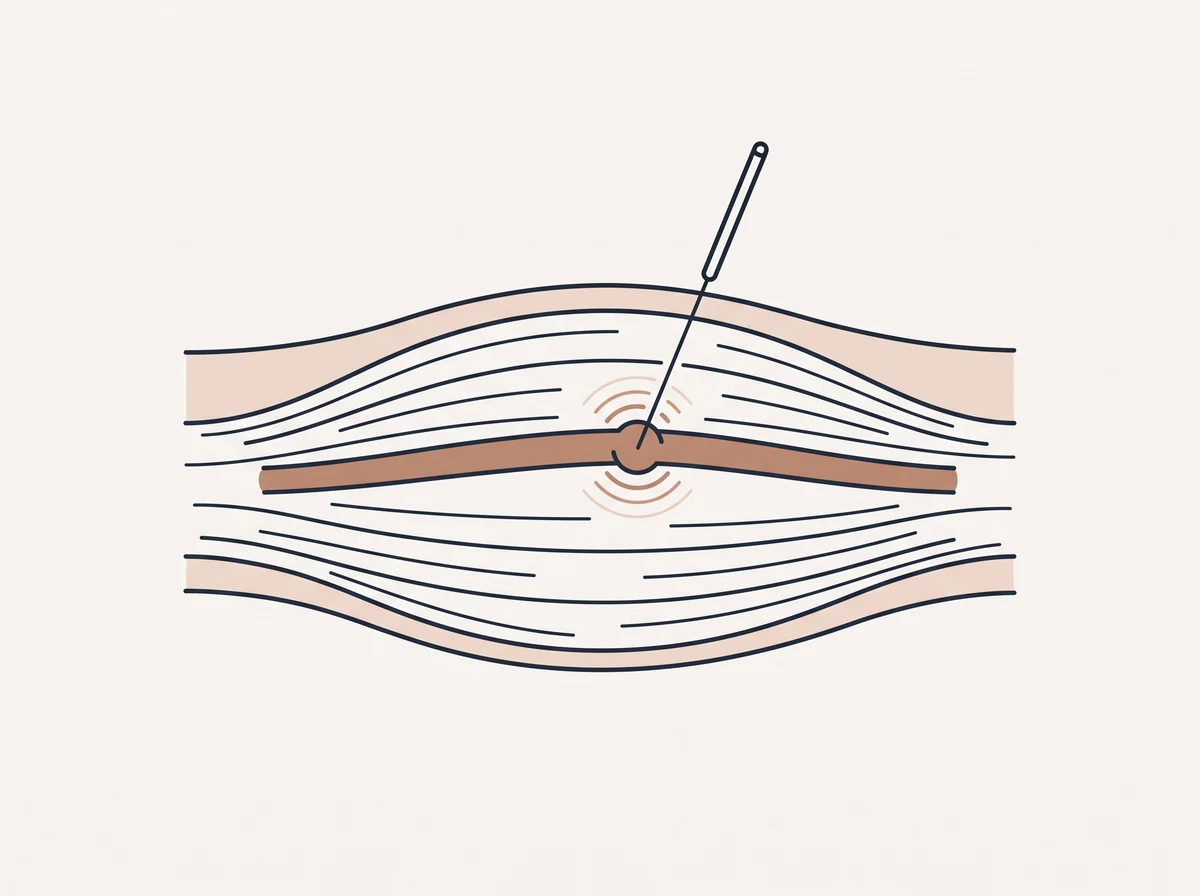
What is a trigger point, and what does the needle do?
When a band of muscle tightens and a pressure-sensitive spot forms along it, that spot is called a trigger point. It can hurt where it sits and also refer pain to places some distance away.
When the needle reaches that point it produces a brief twitch response. The tension in the muscle drops, blood flow to the area increases and the pain cycle is broken.
Which complaints is it used for?
• Myofascial pain and trigger points, often described as muscular rheumatism
• Neck, shoulder, upper back and lower back pain
• Tennis and golfer's elbow, hip and knee pain
• Headaches caused by muscular tension
• Pain from long hours at a desk and from poor posture
• Muscle shortening that accompanies spasticity after a stroke
Is dry needling enough on its own?
Dry needling reduces pain and spasm and makes movement easier, but on its own it does not remove the cause. Pain is usually tied to posture, weak muscles or a faulty movement habit. If exercise and postural work do not follow the needling, the complaint is expected to return.
What patients ask most
Does dry needling hurt?
The needles are as fine as a hair and most patients do not notice them. There may be a brief twitch or cramp-like sensation inside the muscle, gone within seconds. Feeling as though you have exercised hard is normal afterwards.
Is it the same as acupuncture?
No. Acupuncture places needles on traditional meridian points and leaves them for a set time. Dry needling places the needle directly into the muscle and the trigger point, and the aim is to release the muscle. It is based on modern anatomy.
How many sessions will I need?
It depends on how severe the pain is, how long it has lasted and how large the area is. Three to six sessions are enough for most patients; sometimes a single session is enough. Long-standing pain can take eight to ten.
How will I feel afterwards?
Mild muscle soreness and tenderness for 24 to 48 hours is the expected response. Small bruises at the needle sites can appear and clear by themselves. Drinking water and avoiding heavy exercise that day makes it easier.
Who should not have it?
People with bleeding disorders or on blood thinners need medical clearance. It is not used where there is infection, an open wound or marked swelling, in limbs with lymphoedema, or for patients with a needle phobia. In pregnancy, certain areas require a doctor's advice.
Is dry needling right for you?
Let us assess the source of your pain where you are. Our physiotherapist comes to your home, examines the muscles, tells you whether dry needling is appropriate and sets out a programme. This first assessment is free.
Call us+90 (212) 983 40 67
This page is for information only and does not replace examination or medical diagnosis.