
WHAT IS CUPPING THERAPY?
WHAT CUPPING DOES
WHERE IT IS USED
- Session length
- 15 – 25 min
- Sessions needed
- Usually 4 – 6
- Anaesthetic
- Not required
- Pain
- Minimal
- Back to normal
- Same day
- First effect
- 1 – 2 sessions
- Marks last
- 3 – 7 days
- Where
- Your own home
The session, step by step
Cupping is carried out by your physiotherapist in your own home. Including preparation, the visit takes under half an hour.
- I. ASSESSMENT
Examination
Tight and tender areas are examined by hand. Blood thinners, skin conditions and pregnancy are asked about before anything is applied.
- II. PREPARATION
Preparing the skin
The area is cleaned and a thin layer of oil applied so the cup can glide. Cups are cleaned separately for each patient.
- III. TREATMENT
Suction
The cups are placed and the air drawn out to create negative pressure. A cup may be held in one place or slid along the muscle. The application lasts 15 to 25 minutes.
- IV. AFTERWARDS
What follows
Round red or purplish marks remain on the skin. They are painless and fade by themselves within three to seven days. Drink plenty of water that day and avoid very hot showers and heavy exercise.
Why patients choose it
What stands out when it is compared with other release techniques.
No medication
No drug and no solution are involved, so there is no risk of a drug side effect.
Increases circulation
The negative pressure speeds blood flow through the area, bringing more oxygen to the tissue and helping waste products clear.
Reaches deep tissue
Tension in deep muscle layers that are hard to reach by hand releases as the tissue is drawn upwards.
Range of movement
As the muscles and the fascia over them release, shoulder, back and lower back movement becomes easier.
Short session
Fifteen to twenty-five minutes. It fits into the programme without disrupting your day.
Done at home
No clinic journey and no waiting. It is carried out on your own bed or treatment mat.
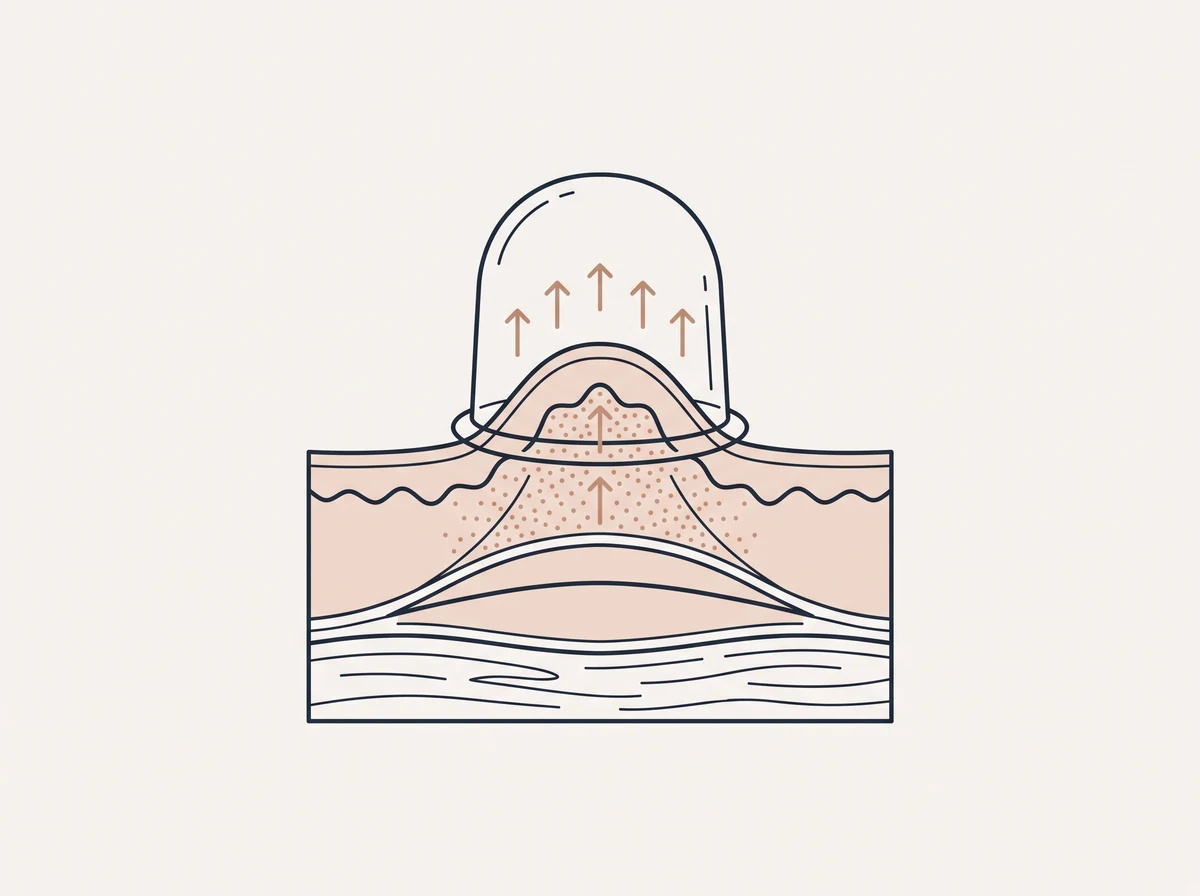
What does the cup do under the skin?
When the air inside the cup is drawn out, the negative pressure lifts the skin and the connective tissue beneath it. This is the opposite of what massage and hands-on techniques do, which is to press the tissue down.
As the tissue lifts, adhesions between it and the muscle loosen and blood flow to the area rises markedly. The redness you see afterwards is the sign of that increased circulation — it is not an injury and it is not a bruise.
Which complaints is it used for?
• Chronic muscle tension in the back and lower back
• Neck and shoulder tightness, pain from long hours at a desk
• Muscle fatigue in athletes after training
• Myofascial pain and trigger points
• Fascial restriction that limits movement
• As support alongside massage and manual therapy
Dry cupping and wet cupping are not the same
In dry cupping only suction is applied and the skin is never broken. That is the method used within physiotherapy, and it is what we apply at home. In wet cupping (hijama) superficial cuts are made and a small amount of blood is drawn; that is a medical procedure and not a physiotherapy service. What we provide is dry cupping.
What patients ask most
Are the marks normal, and how long do they last?
They are normal. The marks are not bruises but increased circulation showing at the surface. They usually fade within three to seven days. How dark they are depends on how tight the area is, and they are usually lighter in later sessions.
Does cupping hurt?
You feel a pulling sensation and pressure, but pain is not expected. On very sensitive areas the suction is reduced. Mild tenderness can last about a day afterwards.
How many sessions will I need?
It depends how long the complaint has lasted. Four to six weekly sessions are enough for most patients. Athletes and people under constant tension sometimes continue monthly as a preventive measure.
Can I shower or exercise afterwards?
Avoid very hot showers, saunas and heavy exercise for a few hours. The next day you can return to your normal routine.
Who should not have it?
People with bleeding disorders or on blood thinners need medical clearance. It is not used where there is an open wound, eczema, infection, advanced varicose veins or a tumour in the area, over the abdomen and lower back in pregnancy, or in advanced heart or kidney failure.
Is cupping right for you?
Let us assess where the tension comes from. Our physiotherapist comes to your home, examines the muscles, tells you whether cupping is appropriate and sets out a programme. This first assessment is free.
Call us+90 (212) 983 40 67
This page is for information only and does not replace examination or medical diagnosis.