
OUR HOME PHYSIOTHERAPY SERVICES
Neurological Rehabilitation
Orthopaedic Rehabilitation
Paediatric Rehabilitation
Geriatric Rehabilitation
Respiratory Rehabilitation
Vascular Rehabilitation
- First assessment
- Free
- Session length
- About 60 min
- Frequency
- 2 – 3 per week
- Applied by
- Physiotherapist
- Where
- Your own home
- Equipment
- Brought by the physiotherapist
- Areas covered
- Six specialisms
- Carer needed
- No
How treatment progresses
Whichever area of rehabilitation you need, the process runs through the same five steps. We set the goal together with the patient and the family, and we follow progress by measuring it.
- I. START
Free first assessment
Your physiotherapist comes to your home and assesses both the patient and the setting. Which movements are difficult, and which parts of the home need adjusting, are seen on the spot.
- II. PLANNING
Setting goals
We talk through what matters most to the patient and the family. Concrete goals — “to reach the bathroom unaided”, “to walk indoors with a stick” — are agreed, and the programme is built around them.
- III. TREATMENT
Running the programme
Sessions continue at the planned frequency. What is done in each session, and the measurements taken, are recorded so progress can be followed.
- IV. REVIEW
Reassessment
Measurements are repeated at set intervals. The programme is updated according to where the patient has got to, and goals are reset if needed.
- V. CONTINUITY
Moving to a home programme
Once the goals are reached, sessions become less frequent. The patient and family are taught enough to carry the programme on themselves.
What happens in a session?
A session usually lasts an hour and has four parts.
Warm-up and joint movement
The session begins by preparing the muscles and joints. For bed-bound patients this part is done in bed, with positioning and passive movement.
Work towards the goal
Strengthening, balance or gait work. Which of these is done is decided by the goals set at the first assessment.
Supporting methods
Where useful, electrotherapy, manual therapy, kinesiology taping or dry needling is added to the programme.
Cool-down and home exercises
The session ends with cool-down movements and a reminder of the exercises to be done on the days in between.
What does the physiotherapist bring?
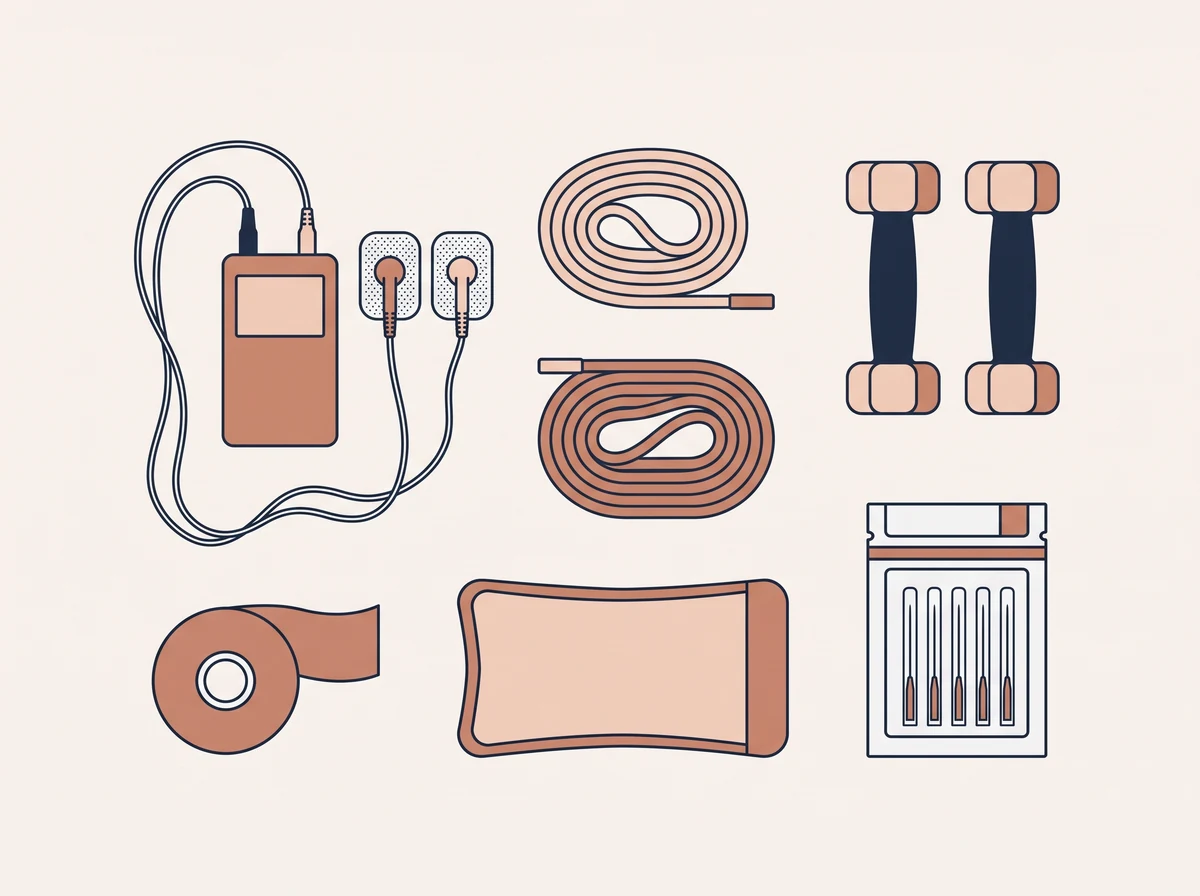
So that treatment at home lacks nothing compared with a clinic, everything needed comes with the physiotherapist: a portable electrotherapy unit, hot and cold packs, resistance bands, small weights, balance equipment and, where required, kinesiology tape and sterile needles. There is no device for you to buy or hire.
When is home treatment not appropriate?
Patients who need continuous medical supervision or intensive-care level monitoring, and programmes that require clinical equipment such as hydrotherapy pools or robotic gait systems, cannot be treated at home. If the assessment shows that this is what is needed, we say so plainly and refer the patient to a suitable centre. Home treatment is not recommended to everyone — only to patients it suits.
What patients ask most
Who carries out the treatment?
Sessions are carried out by experienced physiotherapists. For each area of rehabilitation we assign a physiotherapist who has worked in that field.
Do you bring the equipment?
Yes. The portable devices and exercise materials needed come with your physiotherapist. There is nothing you need to buy.
How many sessions will be needed?
It depends on the diagnosis. A few weeks can be enough for an orthopaedic problem, while neurological rehabilitation runs over months. We give you a clear number after the first assessment.
The patient is bed-bound — is treatment still possible?
Yes. We begin with positioning in bed, joint movement and breathing work, and move on to sitting and standing as the patient's condition allows.
What sort of space is needed at home?
No special room or equipment is required. A bed or couch the patient can lie on comfortably, enough space for the physiotherapist to move around, and no loose rugs on the floor is enough.
The first assessment is free
Call even if you are not sure which area of rehabilitation you need. Our physiotherapist comes to your home, assesses the patient and the setting, and tells you which programme fits and roughly how many sessions it will take. There is no charge for this first visit.
Call us+90 (212) 983 40 67
This page is for information only and does not replace examination or medical diagnosis.