
WHY CHOOSE PHYSIOTHERAPY AT HOME
A physiotherapist at your door.

 Written by: Muhammet Talha Bagdat, PT | Physiotherapist | Last updated: 20 September 2026
Physiotherapy at home is a far less demanding route to treatment. The physiotherapist works one to one with the patient for the whole session, which speeds recovery; and because every reaction is seen as it happens, it is clear at each stage which direction the treatment should take.
How does home physiotherapy work?
A home programme is equivalent to a clinic programme. What matters is that the patient returns to their previous health, or makes ground towards it, in a reasonable time. To follow the patient closely, a range of equipment and methods is used together.
Treatment at home means the setting is arranged around the patient rather than the other way round. The methods applied are the same as those used in a physiotherapy centre.
Why the journey to hospital is exhausting
Most patients who need physiotherapy already have difficulty moving. Stairs, getting into a car, the journey itself and the wait use up the patient's energy before the session starts. For patients after a stroke, after joint replacement, and for older patients, there is also a real risk of falling during the transfer. Treatment at home removes that risk and lets the patient spend all their energy on the treatment.
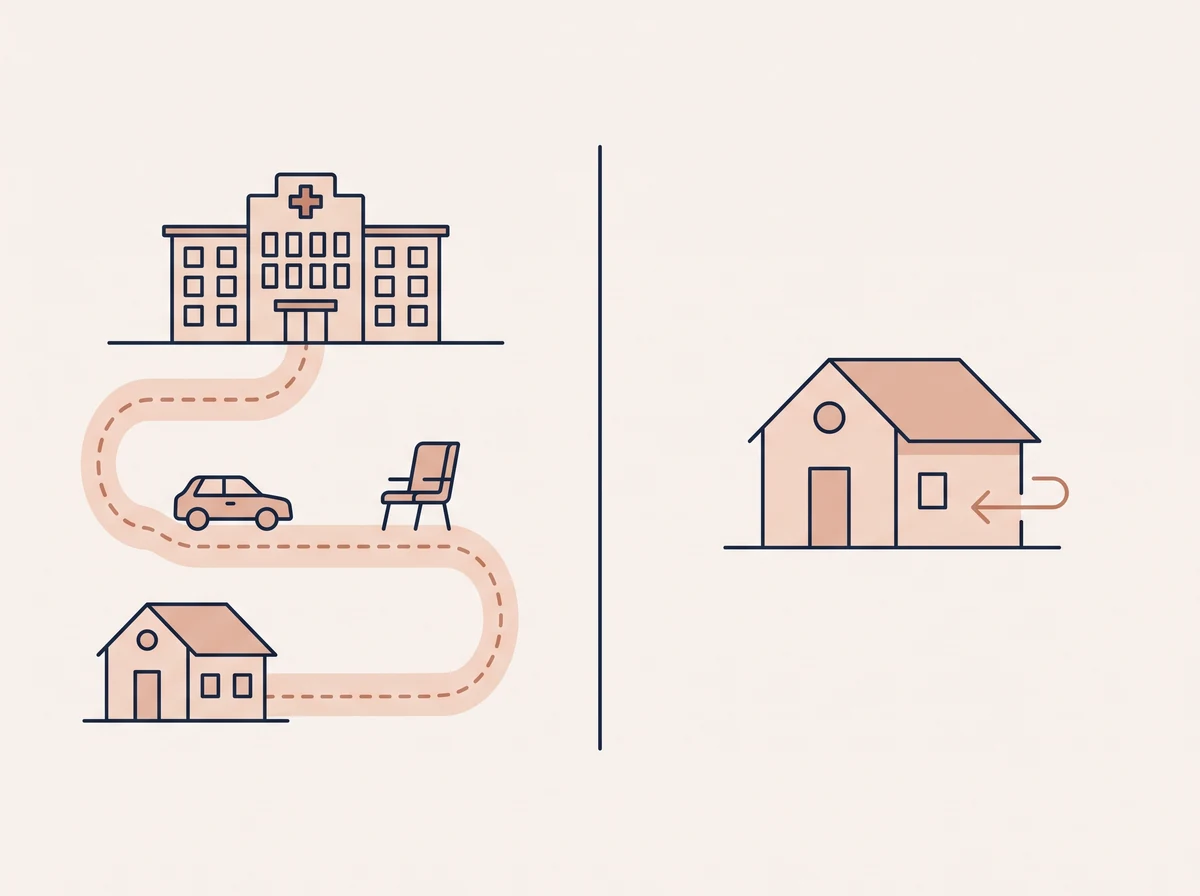
Treatment in the real environment
A patient who walks well on the level floor of a clinic can struggle at their own doorstep or in a narrow hallway. Working at home means the patient learns to get out of their own bed, into their own bathroom and up their own stairs. The physiotherapist can also suggest changes to furniture, lighting and grab rails on the spot.
The family takes part
In a home session the family sees the treatment, learns the correct transfer techniques and picks up the exercises to be repeated between visits. That matters: most of the hours in a week are the hours between sessions.
Infection risk and privacy
For patients with a weakened immune system, after surgery or after intensive care, a busy waiting room carries a real infection risk. Being treated at home removes that contact. For many patients, privacy matters too — exercises are easier to do without an audience.
What are the limits of home treatment?
Home treatment is not suitable for everyone. Patients who need continuous medical supervision, and programmes requiring clinical equipment such as a hydrotherapy pool or robotic gait training, cannot be carried out at home. When our assessment shows that this is the case, we say so and refer the patient to a suitable centre.
What does it cost?
The cost varies with the diagnosis, what each session involves and how many sessions are needed. Since physiotherapy is used for a wide range of conditions, the method and duration can only be decided once the condition is known. After the free first assessment we give you a clear programme and a clear price.
This page is for information only and does not replace examination or medical diagnosis.